Abstract
Fine-grained control over continuous semantic attributes of 3D objects is essential for 3D content creation, but is not well supported by conventional 3D modeling workflows or prompt-based interaction with existing generative AI tools. While slider-based methods have proven effective for fine-grained semantic control in 2D image generation, no equivalent approach exists for 3D. Extending these 2D methods to 3D is non-trivial due to challenges unique to 3D, including geometric integrity and cross-view coherence.
We present SemanticSlider3D, a technique for continuous semantic attribute editing of 3D objects that requires no per-attribute training. Given a user-specified attribute, our pipeline constructs a semantic editing direction in the latent space of a state-of-the-art 3D generation model, presenting a diverse and coherent spectrum of 3D variations.
A technical validation on a dataset of 50 3D object-attribute pairs shows our method was preferred by all five human assessors across variation range, consistency, 3D object quality, and attribute disentanglement, over a baseline combining a 2D slider with an image-to-3D model. An exploratory study with six participants demonstrates that SemanticSlider3D supported decision-making in 3D prototyping and was perceived as a valuable addition to existing workflows.
Try the sliders
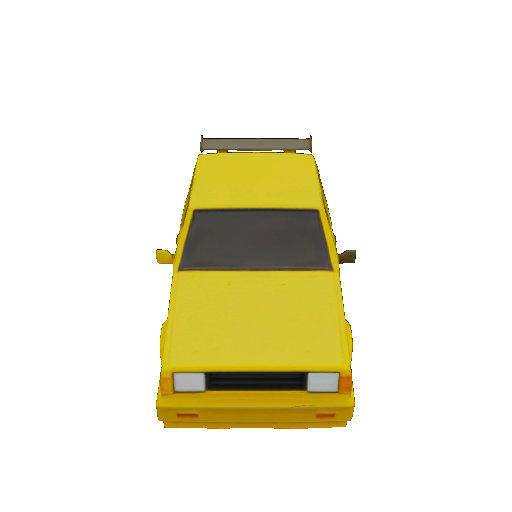
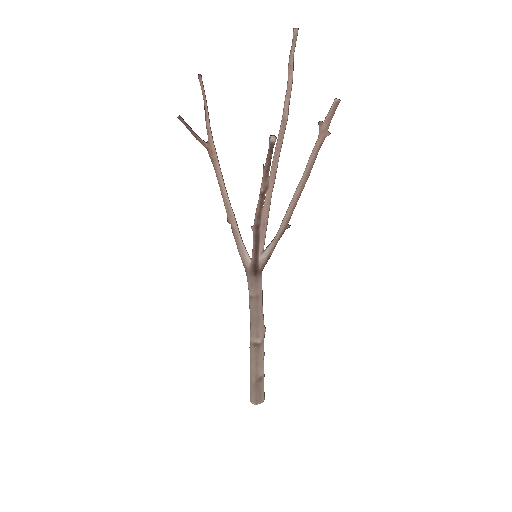
Each slider moves through nine variations produced by one semantic editing direction. The rotation control turns every object at once, so you can check that an edit holds up across views.

Piano · style
Car · style

Book · condition
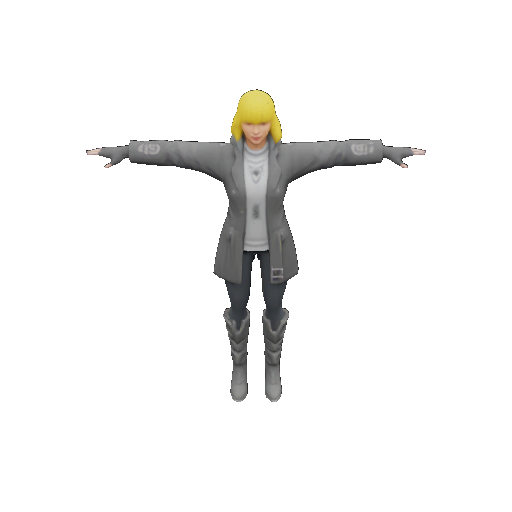
Figure · local spatial
Tree · temporal
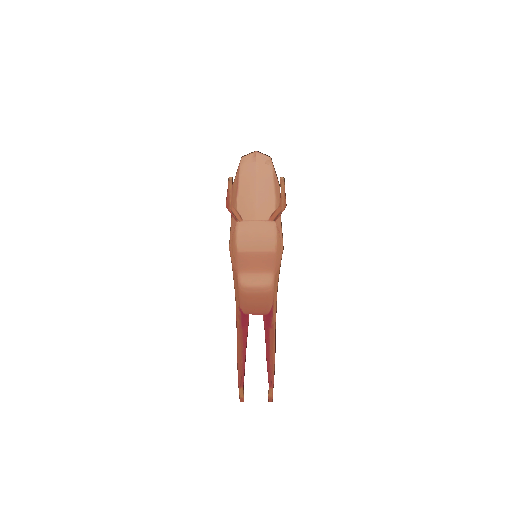
Deer · fidelity
Video
Trouble with the embed? Watch on YouTube.
How it works
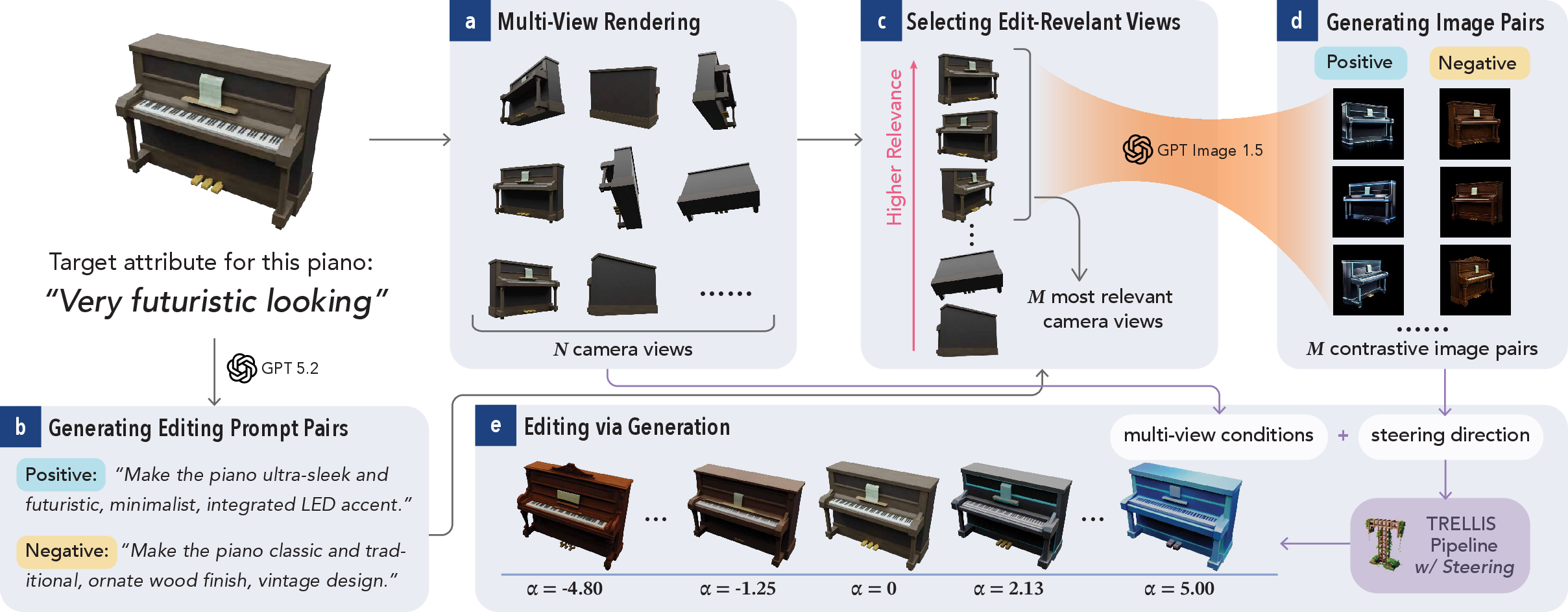
A user-specified attribute becomes a semantic editing direction in the latent space of TRELLIS — no per-attribute training.
-
Generating image conditions
Multi-view images are rendered from the 3D object, and an LLM generates contrastive editing prompts for the positive and negative extremes of the attribute. Edit-relevant views — those that actually carry visual information about the attribute — are ranked by the ImageReward score between the editing prompt and each camera view, verified by a VLM, then edited to produce contrastive image pairs.
-
Editing via generation
Steering directions are computed from the contrastive view pairs by averaging velocity differences across them. Combined with classifier-free guidance, the scaled steering is injected into both stages of the generation model to produce 3D variations at different attribute intensities. TRELLIS represents objects as Structured LATents (SLAT) — local latent vectors on a sparse 3D voxel grid — and its flow matching architecture makes this steering possible at inference time.
-
Mapping latent variations to the slider
Adaptive bounds are determined through quality checking, and perceptual distances are measured with LPIPS. Because generation does not guarantee consistent object orientation across α values, comparing key-frames by rendering order would inflate the measurement with orientation differences unrelated to the actual attribute change — so a minimum-cost bipartite matching pairs each original view with its closest-matching viewpoint in the variation. Variations are then mapped to slider positions by signed perceptual distance and refined iteratively with additional anchor points.
Evaluation
Technical validation
On a dataset of 50 3D object-attribute pairs spanning 46 unique 3D objects — covering local attributes (spatial, expressions) and overall characteristics (shape, style, material, detail, temporal) — our method was preferred by all five human assessors across variation range, consistency, 3D object quality, and attribute disentanglement, over a baseline combining a 2D slider with an image-to-3D model.
Exploratory study
Six participants with prior 3D prototyping experience, ranging from one month to ten years, created objects and sliders across two tasks. The study demonstrates that SemanticSlider3D supported decision-making in 3D prototyping and was perceived as a valuable addition to existing workflows.
BibTeX
@article{wang2026semanticslider3d,
    title={SemanticSlider3D: Training-Free Continuous Semantic Editing for 3D Objects},
    author={Wang, Ru and Jain, Rahul and Niinuma, Koichiro and Gupta, Aakar},
    journal={arXiv preprint arXiv:2608.18560},
    year={2026}
}
Acknowledgments
SemanticSlider3D builds on TRELLIS for structured-latent 3D generation. The playground additionally uses SAM 3D Objects for single-image reconstruction.